
Beet Risotto with Fresh Thyme

This post may contain affiliate links.
In my mind, comfort food should be some combination of quick, easy, aromatic, and colorful. Not all comforting recipes will check off all of those boxes, especially when it comes to color. A LOT of comforting, cozy recipes are fairly monochromatic (mac and cheese, brothy beans, most stews, etc)...But this vibrant pink beet risotto with fresh thyme is cheesy, cheerful comfort! I find it's the perfect antidote to the dreary grey weather of February. And, because it uses pre-cooked beets, once it's on the stove you'll be sitting down to eat in just 15 minutes!

This savory, cheesy beet risotto recipe has the perfect creamy texture without the "traditional" laborious and time-consuming method. You know the one--adding broth one ladle at a time, slooowly stirring over low heat...
This was inspired by my Simple Classic Risotto recipe, using the same incredibly easy and fast method. I've chosen to use chopped beets instead of beet puree (as you might see in other recipes) because I love the texture and look of the deep red pieces of beet nestled into the vibrant pink, creamy risotto. If you're looking for something to round out your meal, I think this dish pairs well with this wonderful parsley and arugula salad!
Table of Contents
Ingredients
When I make beet risotto, I like to keep it fairly simple. Essentially, I'm just adding cooked beets and fresh herbs to my base recipe for risotto. Keeping it simple allows us to really highlight the textures and flavors of the individual ingredients. And it cuts down on prep time!

- Carnaroli or Arborio Rice
- These are both medium grain rice. Carnaroli is my preference--after the hundreds of batches I've made in test kitchens (and at home!) I find that it retains its texture better than Arborio, which is more prone to turning mushy. If it's your first time making risotto, it's nice to have Carnaroli as a helpful safety net.
- It's worth noting, you can use any medium-grain rice, or even short grain rice, regardless of where it's from. It doesn't have to be Italian "risotto rice." The important thing is size, so if you already have a lovely medium grain Japanese rice in your pantry, use that!
- Vegetable Stock or Broth
- I highly recommend homemade broth because boxed broths tend to be overly carroty and cloying. As a result, they completely overpower the delicate flavors of the risotto. If you're using boxed broth, see Substitutions for my suggestions on how to adjust it.
- I use vegetable broth because I find that meat-based broths often yield heavier, stodgier flavored risotto. If choosing meat-based, choose a light stock.
- Cooked Beets
- Cook your beets any way you like. I like the depth of flavor that comes from roasted beets, but steamed and boiled are just as good. If you'd like to bypass the cooking of beets, jump down to the Pantry Swaps section to read about store-bought alternatives.
- Pecorino Cheese
- Finely grated cheese melts into the brothy rice to help turn it creamy and silky. Use freshly grated, good quality cheese--it will have a significant impact on the final flavor, so using the cheap stuff will be noticeable.
- You can also use Parmesan cheese, but I particularly like the way the salty-grassy flavor of Pecorino blends with the earthy sweetness of beets.
- White Balsamic Vinegar
- White balsamic is slightly less acidic than white wine vinegar, with a touch of sweetness. Adding a splash at the end of cooking wakes up the whole pot and balances the richness beautifully. Don't be afraid of it! It's one of the key elements that separates good risotto from heavy, stodgy risotto.
(See recipe card for quantities.)
Basic Method: Video
The method I use in all my risotto recipes stems from my Simple Classic Risotto, which is as about as basic and bare-bones as you can get (while still being utterly delicious). Even though my beet risotto looks wildly different, there actually aren't that many more steps required than for my base recipe!
- 0:00 Intro
- 0:18 Ingredients
- You can use any type of cooked beets, from roasted to canned to pickled.
- 0:45 Toast rice in butter, then add broth
- Add most of your broth right away. No need to do it one ladle at a time.
- 1:09 Stir often, until rice is nearly tender
- Rice will still have a bite, but be nearly tender. Your risotto overall should still be pretty soupy.
- 1:32 Optional: Remove the herb bundle
- If you opted for a bouquet garni instead of plucking and chopping your thyme, fish it out now.
- 1:50 Stir in the beets and add another splash of broth
- This is the adjustment phase. The rice will finish cooking and you have a chance to tweak the texture to your liking.
- 2:05 Remove from heat and add butter, cheese, scallions, and vinegar
- Removing from heat helps to prevent the butter and cheese from splitting or turning clumpy.
- 3:26 Serve immediately
- Tip: warm your bowls or plates before serving. The extra warmth will help preserve the lava flow texture of the risotto.
Basic Method: Photo

Prep your ingredients and pre-heat your broth. Toast the rice in butter.

Add warm broth and bring to a boil. Reduce to medium heat and cook, stirring frequently and briskly, until the rice grains are noticeably more tender but still have quite a firm core.

Add more of the hot broth and the beets. Continue cooking, stirring frequently and briskly, until the rice is just shy of perfect al dente.
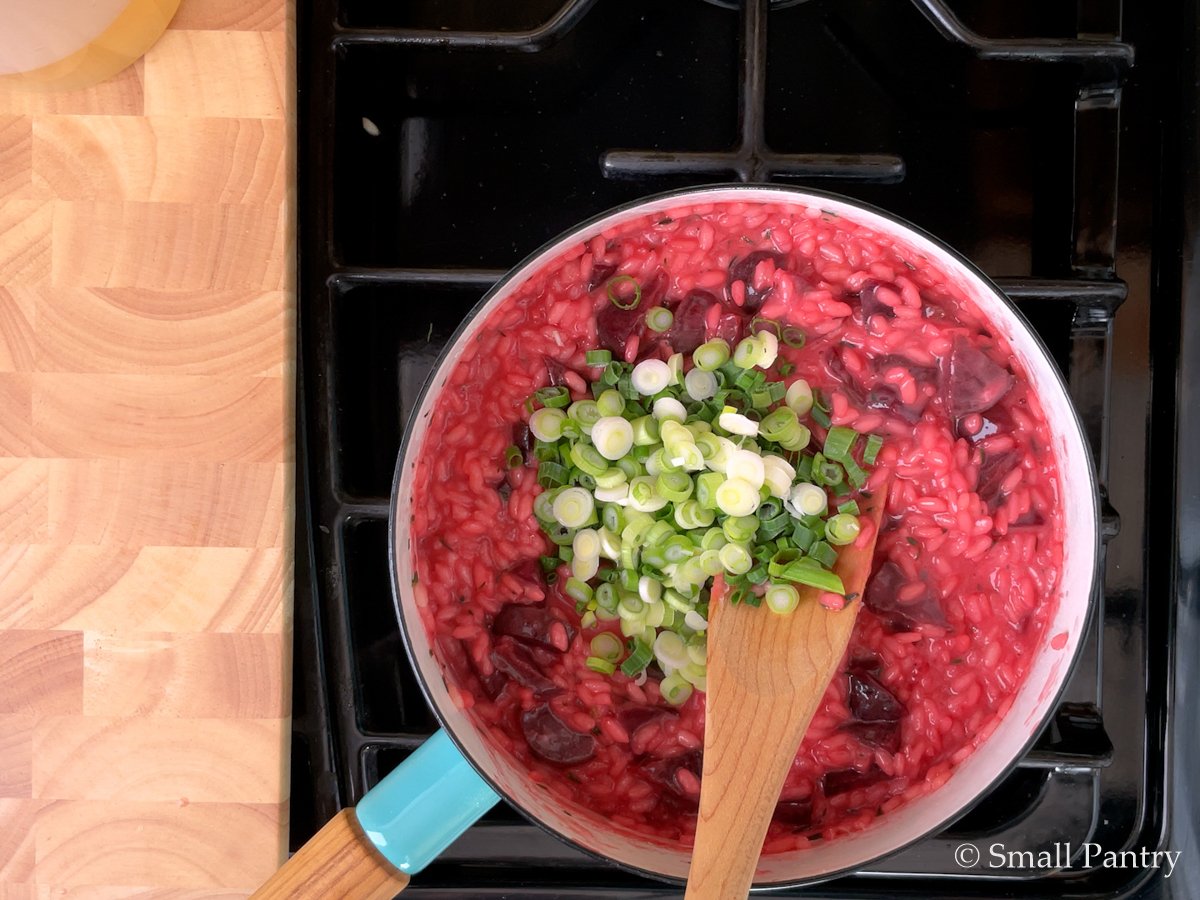
Off heat, stir in Pecorino, vinegar, salt, scallions, thyme, and the remaining butter, 1 piece at a time.
(See recipe card for quantities and times.)
Hint: For more help achieving your ideal texture, hop over to my Simple Classic Risotto post. All of my risotto recipes use the same base, and the post for that simple base recipe is loaded with tips, tricks, and troubleshooting help. Plus another helpful video to show you what each step looks like!
Dietary Swaps
As written, this recipe is vegetarian and gluten free. Hopefully it is simple enough to be easily tailored to your personal dietary needs. The most common questions I've seen are about making a vegan beet risotto and about limiting lactose if lactose-intolerant:
- Vegan Beet Risotto - this is inherently difficult to make vegan without sacrificing both flavor and texture, but I encourage you to play. Swap vegan butter for regular butter. You can use olive oil for toasting the rice, but it won't have the same effect as a butter product when finishing the dish off heat. Try adding some vegan Parmesan alternatives if you can find them in stores (I haven't seen many vegan Pecorino options). Vegan cheeses are becoming more and more sophisticated, so you may have good results (I have not tested any, FYI).
You can also try adding a splash of cashew cream and omitting the cheese altogether. In this case, you will need to adjust seasoning. You might want to experiment with flavor enhancers like nutritional yeast or msg to make up for losing the salty-grassy umami of Pecorino. - Low Lactose - If you are simply limiting lactose, I recommend the vegan butter but keeping the Parmesan. Properly aged Parmesan should be low- to no-lactose because the lactose naturally breaks down as part of the aging process.
Don't be afraid to get creative with your substitutions. Take a look at this seafood risotto with red curry paste and fresh herbs for a bit of pescatarian inspiration!
Pantry Swaps
The wonderful thing about simple recipes like this low-effort beet risotto is that it's easy to adapt a short ingredient list to fit what's in your pantry. Here are a few simple ways to switch up your ingredients while still ending up with a vibrant, savory beet risotto:
- Store-Bought Instead of Homemade Broth - If you prefer to use store-bought, I highly recommend diluting it with water. Because most store-bought broths are much more concentrated than homemade, they end up overpowering the rest of the ingredients. I find this to be especially true for vegetable broths, but also for chicken stock and broth (even low sodium chicken broth!). To use store-bought for this recipe start with roughly 3 cups broth diluted with 1 cup water. If using a salty bouillon paste, dilute it even further. I have liked the Better than Bouillon Roasted Vegetable paste and Low-Sodium Roasted Chicken paste reconstituted with 1 teaspoon paste to 4 cups water--that's a mere 25% of the label's recommendation.
- Using Pre-Cooked Beets - These days it's pretty easy to find vacuum-sealed pre-cooked beets at the grocery store. I often use these as an easy time-saving alternative to cooking my own beets, but just be warned that your color will vary! Some pre-cooked beets end up a dingy brown color, which will make a risotto to match. I have also tested this recipe with store-bought pickled beets and really enjoyed the results! Basically, if you like the taste and texture of your cooked beets, be they roasted, canned, or vacuum-packed, they will do well in this recipe.
- Italian "Risotto Rice" - you can use any medium grain or short grain white rice. It does not need to be Italian. Each variety and size absorbs liquid slightly differently, but this can be accommodated by adding a bit more broth or adjusting the cook time.
- White Balsamic Vinegar - if you can't find white balsamic, or don't want to buy it just for this recipe, use unseasoned rice vinegar, fresh lemon juice, or a good quality white wine vinegar. (Because this risotto is bright pink, you could also get away with red wine vinegar.) Keep in mind, both of these lack the natural sweetness of white balsamic, which softens and balances the acidity. Because of this, you should start with a bit less and then add more to taste. (Do not sub regular balsamic!)
- Goat Cheese Instead of Pecorino - While the overall character of the recipe will be quite different, I also recommend using goat cheese instead of Pecorino. Beets and goat cheese are a natural and popular pairing! The tangy creaminess of goat cheese is delicious with the earthy-sweetness of the beets and the fresh pop of the herbs.
Equipment
Equipment can have a big impact on how a recipe turns out. Your stove and oven will function differently, even if they are the exact same model as mine. Differences in pan size and material will also affect things like cooking time, temperature, and moisture loss. I recommend using a saucepan with at least a 2-quart capacity.
For more in-depth discussion of how to choose your equipment, head over to the Equipment section of my base recipe, Simple Classic Risotto.
Make Ahead and Storage
Risotto notoriously does not store well, nor is it easy to make ahead. It's just one of those main dishes that is always best fresh. That being said, I do have several tips and tricks over on my Simple Classic Risotto recipe page! Broadly speaking, any leftovers can be refrigerated in an airtight container for no more than one week.
I also recommend turning your leftover risotto into a new dish--arancini! (Recipe to come!)
Expert tips & tricks
These tips and tricks apply to all my risotto recipes! For even more expert advice, check out my newsletter archives, where I'm sharing an in-depth look at how to make your perfect bowl of risotto as part of my risotto series.
Using warm broth:
Technically, your broth does not have to be warm. The main thing that the temperature affects is cook time. If you add cold broth it drops the overall temperature of the pot, meaning it will take longer for it to come to a simmer. You need the pot to simmer in order for the rice starches to activate and begin thickening the sauce. Adding warm broth dramatically decreases the time needed to reach simmering temperature, which in turn dramatically decreases the overall cook time.
Never wash your rice:
The starches clinging to the surface of milled (white) rice combine with the broth and dairy to make a silky, creamy sauce. It's this thickening power that blankets every grain in decadent, luscious flavor. Save the surface starches--don't rinse your rice!!
Serve on a warm plate:
This is a bit "extra" for a weeknight, but if you're frustrated by perfect all'ondo texture in the pot turning too-thick by the time you serve and sit, try warming your plate or bowl. Even perfect risotto thickens rapidly as it cools, so spooning it onto a cold or room-temp surface is only going to speed up that process. A warm bowl will help keep it warm longer.
FAQ
I usually recommend a sauvignon blanc or dry riesling with beets. I find that the citrus and mineral flavors of these two grapes works well with the earthy sweet-savory flavor of beets. That being said, I also really like a cabernet franc with this dish. There is often a floral, rose quality to cab francs that I really enjoy with beets, since beets can also hint at floral aromas.
Beets are earthy with plenty of natural sweetness. I like to pair them with all kinds of herbs because the combination of earthy flavors with verdent fresh flavors makes sense to our palates--after all, you can't have fresh greens without earth! I also find that the freshness of acidic ingredients rounds out the natural sweetness in the same way as the freshness of herbs. Vinegar and citrus are therefore natural companions to beets.
If you're looking for a more savory and less tangy/grassy cheese than a goat milk cheese (like chevre) or a sheep's milk cheese (like pecorino), then I recommend a milder fresh cheese like mascarpone or cream cheese (if you want a creamy cheese) or a nutty Parmesan cheese (if you want a savory, umami-forward cheese).
The secret to perfectly textured risotto is the way the rice starches bind to the watery broth and fatty butter and cheese, creating a silky, saucy texture that envelopes the grains of rice. The secret to good risotto flavor is the same for any dish: proper seasoning, including both salt and acidity.
Two of the surest ways to make bland risotto are to use poor quality cheese and to season insufficiently. If you use pre-grated cheese of any type (especially parm from a can...!) then you are adding a shadow of flavor instead of big, nutty, savory flavor! And, if you're under-salting your risotto or forgetting to balance richness with a touch of acidity, then your risotto will be flat and uninteresting.
Technically, yes, you can make risotto in a pressure cooker. I've even developed a beet risotto for a magazine. At some point I'll share my pressure cooker risotto method, but the reality is that it creates more dishes and takes longer than this stovetop method.
Related Recipes
Looking for other recipes that celebrate rice? Try these:


Pairing Suggestions
This bright pink beet risotto is always the main event. Here are some fresh salad recipes to round out your meal:


Beet Risotto with Fresh Thyme
Ingredients
- 4 cups vegetable broth, or your broth of choice (See Notes)
- 6 tablespoons butter, cut into 1-tablespoon pieces, divided
- 1 cup carnaroli or arborio rice
- 8 ounces cooked beets, quartered and sliced ¼-inch thick (See Notes)
- ¾ ounce Pecorino Romano, finely grated on a microplane (scant 1 cup)
- kosher salt
- 4 medium scallions, thinly sliced
- 2 tablespoons fresh thyme, finely chopped
- 2 to 4 teaspoons white balsamic vinegar, or other light vinegar (See Notes)
Preparation
Step 1: Warm the broth
- In a small covered saucepan over medium, bring the broth to a simmer. Reduce to low and keep warm.
Step 2: The main cook
- In a large saucepan or high-sided skillet over medium-high, melt 2 tablespoons of butter. Add the rice and cook, stirring constantly, until translucent at the edges, 1 to 2 minutes. Add 2½ cups of the warm broth and bring to a boil. Reduce to medium heat and cook, stirring frequently and briskly, until the rice grains are noticeably more tender but still have quite a firm core, 8 to 10 minutes. The risotto will still look quite loose and soupy. Adjust the heat as-needed to maintain a vigorous simmer.
Step 3: Adjust texture and add the beets
- Add another ½ cup of the hot broth and the beets. Continue cooking, stirring frequently and briskly, until the rice is just shy of perfect al dente, 3 to 5 minutes. It should still be quite soupy and loose. Remove from heat.The grains of rice will continue to soften in the next step and the texture will stiffen up, so you want the rice just shy of al dente and the overall texture just a bit loose.
- If the rice is still very crunchy but the risotto is already looking thick and sticky, add ¼ cup more of the broth and continue simmering and stirring. Repeat, as needed, adding broth ¼ cup at a time, until the rice is just shy of perfectly cooked.
Step 4: Add cheese, butter, and herbs
- Off heat, stir in the Pecorino, 2 teaspoons vinegar, ½ teaspoon salt, scallions, thyme, and the remaining 4 tablespoons butter, 1 piece at a time. Taste and adjust seasoning with salt and vinegar. Serve immediately.



Leave a Reply